
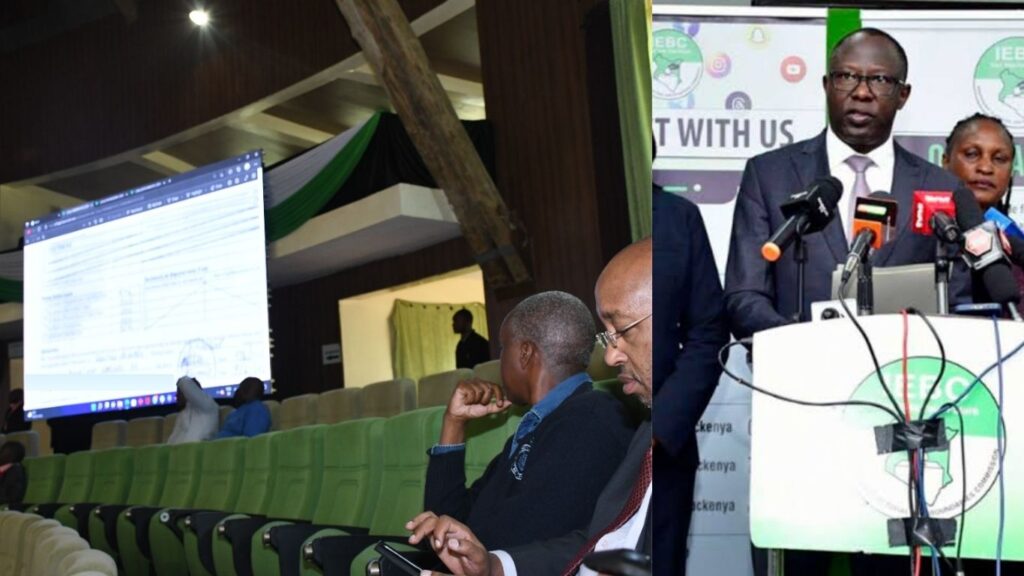
As Kenya prepares for the 2027 General Election, a fresh debate over election results livestreaming is raising a fundamental question: should the country make its electoral process more convenient at the expense of public transparency?
Parliament is considering proposed amendments to the Elections Act that would remove the explicit legal requirement for the Independent Electoral and Boundaries Commission (IEBC) to livestream presidential election results as they are announced at polling stations.
The proposal, contained in the Elections (Amendment) Bill, 2024, has already passed the Senate and is before the National Assembly for consideration. Its supporters argue that results transmission and verification should take priority, while critics warn that removing the livestreaming requirement could weaken public confidence in an already sensitive electoral process.
Why Livestreaming Matters
For many Kenyans, watching election results arrive from polling stations has become an important part of following a national election.
Under the existing legal framework, the IEBC is required to establish a mechanism for livestreaming presidential results as announced at polling stations. The public feed allows journalists, political party agents, election observers and ordinary citizens to follow the figures as they emerge.
The practice gained importance after the disputed 2007 presidential election, which was followed by widespread violence that killed more than 1,000 people and displaced hundreds of thousands.
Subsequent electoral reforms sought to improve transparency and accountability, including by making results more accessible to the public.
The livestream does not replace the official verification process. Its value lies in allowing the public to observe results at their source and compare them with figures later announced by the electoral commission.
What the Proposed Changes Would Mean
The proposed amendments seek to repeal and replace Section 39 of the Elections Act, removing the express requirement that the IEBC establish a mechanism for livestreaming results as announced at polling stations.
However, the proposal does not mean that all electronic transmission of election results would end.
The bill retains provisions for electronic transmission of presidential results and provides for the publication of polling-station results through the commission’s online portal. It also proposes alternative transmission arrangements for areas where electronic networks are unavailable.
The distinction is important because three processes are involved: livestreaming allows the public to watch results being announced; electronic transmission sends results through the electoral system; and publication allows people to access official records, including result forms.
These mechanisms serve related but different purposes. Removing a legal obligation to livestream would not automatically abolish electronic transmission, but it would remove an explicit statutory guarantee of that public-facing feed.
IEBC Faces Questions Over Transparency
The debate comes as the IEBC seeks to build public confidence ahead of the next election.
The commission has argued that the proposed amendments should be understood in the context of improving results transmission and verification, including comparing physical result forms with electronically transmitted images.
IEBC chairperson Erastus Ethekon has also rejected claims that the commission intends to restrict media coverage of elections, maintaining that the commission remains committed to transparency and accountability.
Nevertheless, critics question why the legal requirement for livestreaming should be removed instead of strengthened, particularly when the country is preparing for another highly consequential election.
Former National Assembly Speaker Justin Muturi has defended livestreaming as a tool for transparency and public confidence. Foreign Affairs Principal Secretary Korir Sing’Oei has similarly argued that technological challenges and cybersecurity concerns should be addressed without scrapping the practice.
Can Technology Replace Public Visibility?
Supporters of changing the law argue that a livestream is not the same as a verified election result. They point to the importance of checking official result forms, resolving discrepancies and ensuring that figures used in the final tally are accurate.
That is a legitimate concern. A video feed alone cannot guarantee that every result is correctly recorded, transmitted or verified.
But transparency is not simply about whether the electoral commission has the correct figures internally. It is also about whether the public can independently scrutinise the process and understand how the final outcome was reached.
If livestreaming is removed as a legal requirement, the IEBC could still choose to provide it voluntarily. The difference is that the public would no longer have the same explicit legal assurance that the mechanism must be provided.
A system that combines livestreaming, accessible result forms, independent verification and clear procedures for resolving discrepancies could offer stronger safeguards than relying on any single mechanism.
Lessons From Kenya’s Electoral History
Kenya’s electoral history demonstrates how disputes over results can quickly become disputes over legitimacy.
The 2017 presidential election was annulled by the Supreme Court over significant irregularities and illegalities in the conduct of the election. The case raised serious questions about the management of results and the integrity of the electoral process.
Livestreaming alone did not resolve those challenges. However, public access to results can help journalists, agents and observers identify discrepancies and scrutinise the figures used in the final declaration.
The central issue is therefore not whether livestreaming can prevent every form of electoral malpractice. It is whether removing a transparency measure offers sufficient benefits to justify losing a guaranteed avenue of public scrutiny.
What Is at Stake Ahead of 2027?
The proposed amendments are now before the National Assembly, meaning the final legislative outcome remains important to the debate.
If Parliament proceeds with the changes, the IEBC will still have responsibilities relating to the transmission, verification and publication of results under the proposed framework. But Kenyans will want clear answers about how they will independently follow the process from polling stations to the final declaration.
Ultimately, a credible election requires more than accurate numbers. It requires a process that citizens can scrutinise, understand and trust.
Kenya does not necessarily have to choose between technological efficiency and public transparency. The two can work together if lawmakers strengthen verification procedures while preserving meaningful public access to results.
As the country moves towards 2027, the question for Parliament is whether removing the legal obligation to livestream results solves a genuine problem—or risks creating another trust deficit at a time when electoral confidence matters most.