
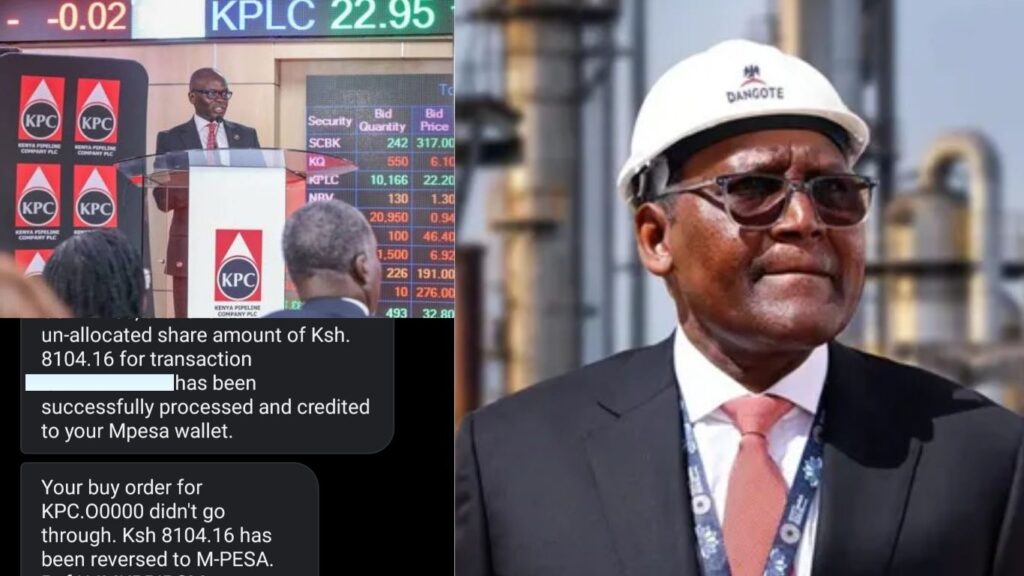
Nairobi, Kenya — Complaints from Kenyan investors about difficulties accessing or trading Kenya Pipeline Company (KPC) shares are adding to growing scrutiny of the government’s share-sale programme after Nigerian billionaire Aliko Dangote acquired a 24.76% stake in the state-linked petroleum transporter.
The transaction, valued at approximately KSh42.5 billion, involved about 4.5 billion shares sold by major shareholders, including state-backed institutions. Dangote confirmed the acquisition on October 21, 2026, saying the investment would support petroleum-product distribution.
The deal has triggered a wider public debate: are Kenyans getting a fair opportunity to invest in strategic national companies, or are large institutional investors and wealthy buyers gaining an advantage over ordinary citizens?
How Did Dangote Acquire the KPC Shares?
KPC shares began trading on the Nairobi Securities Exchange in March 2026 after the government sold part of its stake through an initial public offering (IPO).
The offer was priced at KSh9 per share and raised approximately KSh112 billion, exceeding the government’s target. However, participation by ordinary local investors was relatively low: retail investors purchased shares worth KSh4.1 billion against an allocation of KSh21.2 billion, according to figures reported by Business Daily.
State-backed institutions played a significant role in the IPO. Among the major investors were the National Social Security Fund, the Public Service Superannuation Scheme, the County Workers Pension Fund and the Unclaimed Financial Assets Authority.
Less than eight months later, several major shareholders sold a combined 24.76% stake at approximately KSh9.02 per share.
The subsequent transaction has raised questions about why public institutions accumulated substantial holdings before selling a large block to a private investor.
Why Are Investors Raising Concerns?
Some Kenyan investors say they have encountered difficulties buying or trading KPC shares and are questioning whether ordinary retail investors have a fair chance to participate in major transactions.
Those complaints deserve attention, but the cause of the reported difficulties remains unclear. It would be premature to conclude that investors have deliberately been locked out without evidence identifying whether the problem involves brokerage platforms, trading procedures, liquidity or another restriction.
The distinction matters because a large block trade between major shareholders is different from an individual investor placing an ordinary buy or sell order through a licensed stockbroker.
The Nairobi Securities Exchange and relevant market regulators would need to clarify whether any trading restrictions or technical problems affected retail investors and, if so, what caused them.
Did Public Institutions Take an Unnecessary Risk?
Kiharu MP Ndindi Nyoro has questioned the role of public institutions in the KPC transactions, alleging that government pressure led pension-related funds and other state-backed entities to buy shares before selling them to a private investor.
Nyoro has also argued that transaction costs and the time value of money could have reduced the institutions’ returns. These are his allegations and calculations; determining the actual financial outcome requires the institutions’ individual purchase prices, sale proceeds, fees and investment records.
The published prices alone do not establish whether the sellers made a profit or a loss. Selling at KSh9.02 after buying at KSh9 would produce a small gross price gain, but transaction costs and the timing of the investments would affect the net return.
The central issue is whether the institutions made sound investment decisions in the interests of their beneficiaries.
Is President Ruto Selling Kenya’s Companies to the Highest Bidder?
The KPC transaction has reignited debate about President William Ruto’s privatisation programme and the sale of stakes in strategic national companies.
Supporters of private investment argue that bringing in experienced investors can provide capital, expand infrastructure and improve commercial performance. Dangote has said his KPC investment fits into a broader strategy to strengthen petroleum distribution across Africa.
Critics, however, want greater transparency over how strategic assets are sold, how buyers are selected and whether ordinary Kenyans receive a fair opportunity to participate.
The transaction itself does not establish that the government improperly favoured Dangote. Nor does the available evidence establish allegations that President Ruto has undisclosed financial interests in the deal. Those claims require independent verification.
What the transaction does establish is that a major stake in a strategically important Kenyan company has moved into private hands, making transparency over ownership, governance and future investment plans especially important.
What Should Happen Next?
The relevant authorities should clarify the circumstances surrounding the reported trading difficulties, explain how the block transaction was conducted and provide information that allows the public to assess the financial outcome for the selling institutions.
The NSE and Capital Markets Authority should also address any substantiated complaints about retail investors being unable to trade, including whether the issue arose from technical failures, market rules or another cause.
For pension-related institutions, beneficiaries deserve a clear account of why the shares were purchased, why they were sold and what returns were realised after costs.
Kenya’s debate is no longer only about who bought KPC shares. It is about whether privatisation is being conducted transparently, whether public institutions are protecting their beneficiaries’ money and whether ordinary Kenyans can participate fairly in the country’s capital markets.