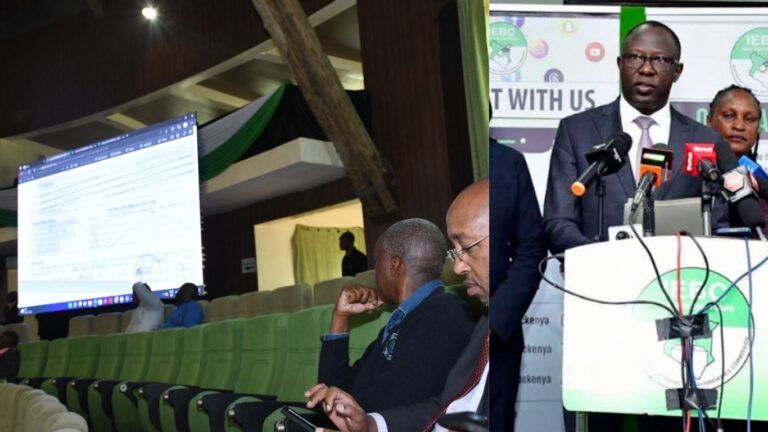
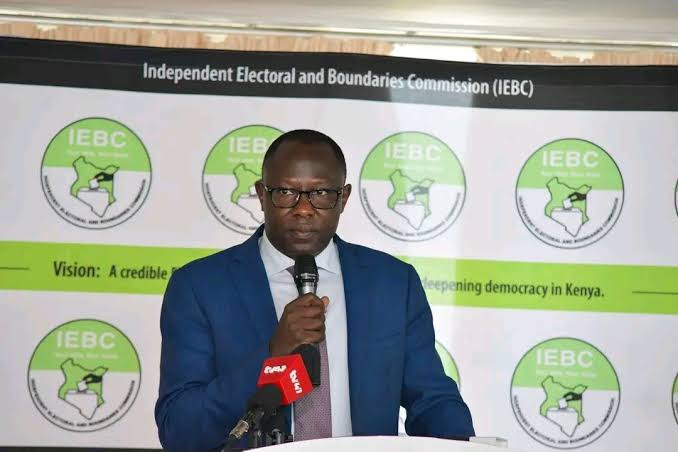
Chairperson Erastus Ethekon says broadcasting results from more than 50,000 polling stations would require billions of shillings, cameras and thousands of additional personnel as pressure mounts for greater electoral accountability.
The Independent Electoral and Boundaries Commission (IEBC) has raised fresh concerns over the transparency of the 2027 General Election after admitting that it currently lacks the financial and logistical capacity to livestream results from polling stations across the country.
IEBC Chairperson Erastus Ethekon said the commission would face enormous financial and operational challenges in implementing nationwide livestreaming, with the exercise requiring cameras, broadcasting equipment and technical personnel at more than 50,000 polling stations.
Speaking during an engagement with political journalists in Nairobi on Tuesday, November 24, Ethekon questioned the practicality of installing cameras and deploying staff to every polling station, arguing that the exercise could cost billions of shillings.
His remarks have reignited debate over electoral transparency, particularly as Kenya prepares for the August 2027 General Election, with political leaders and civil society organisations demanding stronger safeguards against manipulation of election results.
IEBC cites billions in costs
According to Ethekon, implementing a nationwide livestreaming system would require the commission to procure thousands of cameras, install the necessary equipment and recruit, train and deploy personnel to operate the system.
The commission would also need reliable internet connectivity, technical support and infrastructure capable of transmitting live footage from polling stations spread across the country.
IEBC Director of Legal Services Chrispine Owiye also indicated that livestreaming in its full form would require substantial financial investment, although he maintained that the electronic transmission of election results would continue.
The commission argues that it must balance demands for additional transparency measures against the already high cost of conducting elections in Kenya.
However, the admission has raised questions about how IEBC intends to fulfil its responsibilities if the necessary infrastructure is not available.
But does the law require IEBC to livestream results?
The commission’s position comes amid an important legal development concerning Section 39(1G) of the Elections Act.
The provision requires IEBC to establish a mechanism for livestreaming results as announced at polling stations for purposes of public information.
In a September 22, 2026 ruling, the High Court addressed the legal position surrounding the livestreaming requirement, restoring the provision following earlier litigation that had challenged its constitutionality.
The National Assembly subsequently clarified in October that the requirement had been retained in the Elections (Amendment) (No. 2) Bill, 2024, after MPs removed the controversial clause that would have altered Section 39 of the Elections Act.
The provision is therefore an important part of the legal framework governing electoral transparency ahead of the 2027 polls.
The distinction is significant: IEBC’s concerns about funding and implementation do not, by themselves, erase a legal obligation. The commission must explain how it intends to comply with the law.
Livestreaming is not the same as transmitting results
The debate has also highlighted the difference between livestreaming election proceedings and electronically transmitting results.
Electronic transmission involves sending results from polling stations through the electoral system to designated tallying centres.
Livestreaming, on the other hand, allows the public to watch results being announced at polling stations in real time.
The publication of official polling-station result forms is another separate transparency mechanism that allows political parties, journalists and voters to compare declared figures with the records uploaded by the commission.
Although these systems complement one another, they are not interchangeable.
IEBC has maintained that electronic transmission of results will continue, but its latest position raises questions about whether Kenyans will also have access to the live broadcasts required for public information.
IEBC says journalists and observers will monitor the process
Ethekon has defended the commission’s approach, pointing to the role of journalists, political party agents and election observers in monitoring voting, counting and the announcement of results.
The commission has also indicated that it is working with media organisations through a joint working group to facilitate journalists’ presence at polling stations across the country.
Journalists are expected to have access to constituency tallying centres to observe the verification and announcement of results.
However, physical media presence is not necessarily a substitute for an official livestreaming mechanism.
A livestream provides a common, accessible record of proceedings that can be viewed by citizens who are unable to send representatives to individual polling stations.
Bomas tallying centre also in focus
The IEBC chairperson also defended the continued use of the National Tallying Centre at Bomas of Kenya, dismissing calls for its abolition.
The commission maintains that the national centre plays an important role in the collation and declaration of presidential election results under Article 138 of the Constitution.
The debate over Bomas has intensified as opposition leaders demand greater transparency in the management of presidential results.
The commission, however, maintains that results declared at polling stations form the foundation of the electoral process, while the national tallying stage serves the constitutional process of collating and declaring the presidential outcome.
Funding shortfall raises further concerns
IEBC’s admission comes as the commission faces substantial financial demands ahead of the 2027 elections.
The electoral agency requires funding for voter registration, replacement of KIEMS kits, election technology, recruitment and training of temporary officials, procurement of election materials and nationwide logistical operations.
Adding a nationwide livestreaming system would introduce another significant expenditure.
The challenge now is whether the government will provide the resources required for IEBC to meet its legal obligations while completing other critical preparations.
What does this mean for the 2027 election?
The latest remarks have reopened a critical question: How can Kenyans independently scrutinise the announcement of election results if the commission does not have the capacity to livestream proceedings from polling stations?
For an election whose credibility will depend heavily on public confidence, transparency cannot be treated as an optional extra.
IEBC will need to provide a clear explanation of its proposed livestreaming arrangements, the estimated cost, the funding required and whether alternative technical solutions can meet the legal requirement.
The commission must also clarify how it will ensure that journalists, party agents and election observers have meaningful access to the counting and tallying processes.
As the country moves closer to August 2027, the debate is no longer simply about the cost of cameras. It is about how the electoral commission will guarantee openness, accountability and public confidence in the announcement of results.