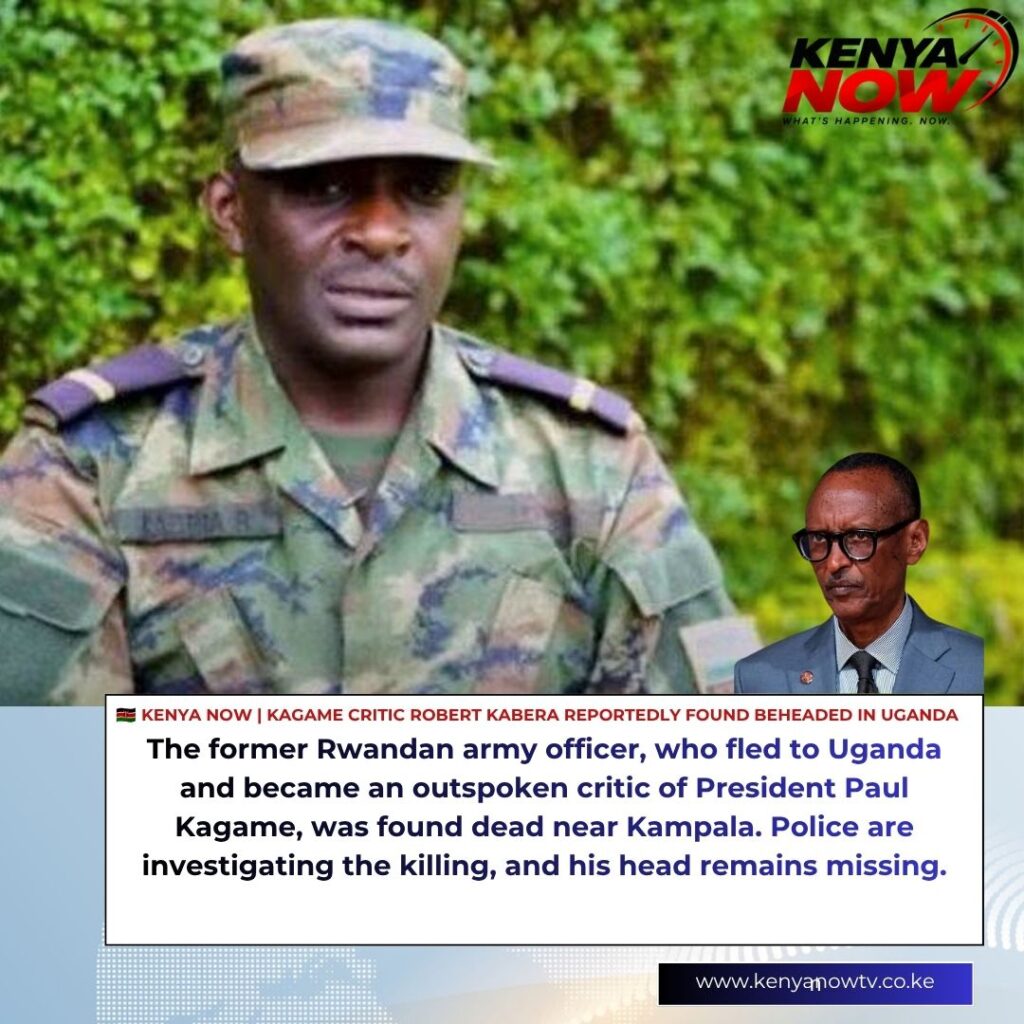
Robert Kabera, a former Rwandan army sergeant major who became an outspoken critic of President Paul Kagame, has been found beheaded in neighbouring Uganda, raising fresh concerns about the safety of Rwandan dissidents living in exile.
Kabera, 50, was found dead on the outskirts of Kampala over the weekend, with Ugandan police confirming that his head had not been recovered as investigations continued.
His body was discovered by local residents in Luwala village, Kamengo sub-county, Mpigi District, on Saturday, October 17, 2026.
Ugandan police spokesperson Kituuma Rusoke said authorities were investigating the killing, but the motive and identities of those responsible had not been established in the initial reports.
Widow fears for family’s safety
Kabera’s death has left his widow, Jeanne d’Arc Rwigema Uwizeye, fearing for the safety of herself and their children.
Speaking to BBC Great Lakes in a written message, she described the uncertainty facing the family following the killing.
“It is scary. I feel crazy, the children and I don’t have security,” she said.
Her remarks have added to concerns about the safety of Rwandans who flee their country and continue criticising its leadership while living abroad.
What happened before Kabera’s death?
According to his family, Kabera had travelled to inspect a construction site approximately 45 kilometres outside Kampala before his death.
Local residents discovered his body, and relatives subsequently identified him.
Ugandan authorities were investigating the circumstances surrounding the killing, with the missing head remaining a key concern for investigators.
Police had not publicly established whether the killing was politically motivated or connected to another dispute.
From army officer to outspoken Kagame critic
Kabera previously served in the Rwandan military and was known as a sergeant major. He later developed a public profile as a musician and online content creator.
His YouTube channel, Major Robert TV, attracted more than 144,000 subscribers and featured over 800 videos, many of which criticised President Kagame and his administration.
He left Rwanda and sought asylum in Uganda, saying he feared political persecution.
However, his departure also followed allegations of sexual misconduct. Kabera denied the accusations, according to reports.
The Rwandan government had not publicly commented on his killing in the reports published on Monday, October 19.
Killing renews questions about Rwandan dissidents in exile
Kabera’s death has drawn attention to previous cases involving Rwandan opposition figures and government critics who died outside their country.
In December 2014, Patrick Karegeya, a former Rwandan intelligence chief who became a critic of Kagame and helped establish the opposition Rwanda National Congress, was found dead in a hotel room in Johannesburg, South Africa.
Karegeya had left Rwanda and settled in South Africa, where he became an outspoken opponent of the Rwandan government.
In 2019, South African authorities issued arrest warrants for two Rwandans accused of murdering him.
Other Rwandan exiles have also been killed in separate incidents in different countries, including former army lieutenant Revocat Karemangingo, who was shot dead in Mozambique in 2021, and opposition figure Seif Bamporiki, who was killed in South Africa that same year.
These cases have repeatedly raised questions about the security of Rwandan critics living beyond the country’s borders.
The allegations surrounding such killings have not, however, established who was responsible for Kabera’s death.
Investigation continues
For now, investigators in Uganda face the task of determining who killed Kabera, locating his missing head and establishing the circumstances surrounding the crime.
His family is also left seeking answers while worrying about what the killing could mean for their safety.
Kabera’s death comes as he is remembered not only for his military background but also for his online criticism of Rwanda’s leadership.
Whether his murder was connected to his political views remains unconfirmed, and investigators have yet to publicly establish a motive.
The case has nevertheless renewed international attention on the risks faced by some political dissidents living in exile and the need for a thorough investigation to bring those responsible to justice.