
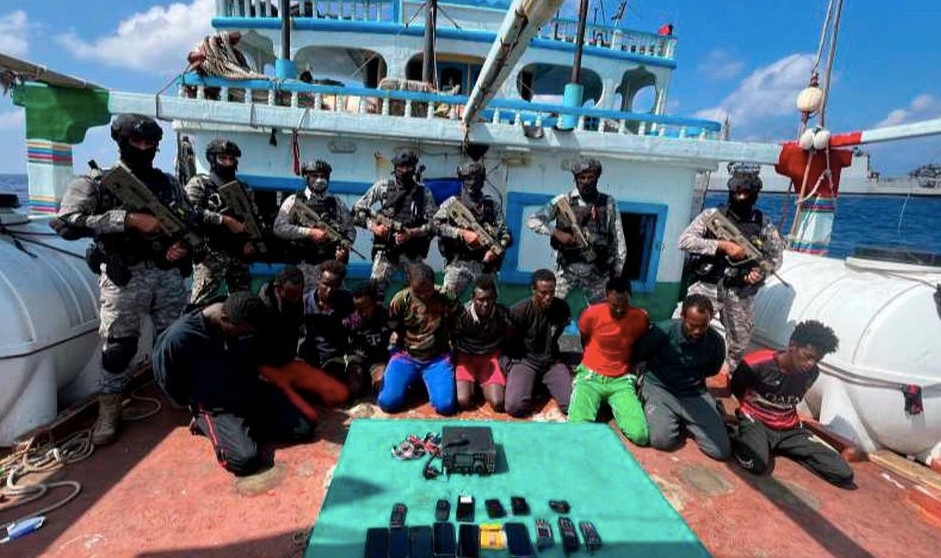
A fresh wave of pirate attacks off Somalia is raising concern over the safety of commercial shipping, with maritime authorities warning that hijacked vessels could be used to launch further attacks in the Indian Ocean.
Maritime security incidents off Somalia’s coastline are increasing, bringing renewed attention to one of the world’s most important international shipping corridors.
The latest concern follows the reported hijacking of an Iranian fishing vessel, Azini, by armed pirates on October 29, 2026, off northeastern Somalia.
According to the European Union’s Maritime Security Centre Indian Ocean (MSCIO), the vessel was seized while carrying 21 Iranian fishermen and two Somali security guards.
The vessel’s movement towards major commercial shipping routes has raised fears that it could be used as a so-called pirate mothership, allowing attackers to operate farther offshore and target larger merchant ships.
The whereabouts and safety of the 23 people aboard remained unknown in reports published earlier this month.
Nine Hijackings Reported in 2026
The renewed activity is part of a wider resurgence of piracy along Somalia’s coastline.
An analysis published by the Institute for Security Studies (ISS) on November 6 reported nine hijackings attributed to local raiders in 2026.
One of the latest incidents involved the Iranian fishing vessel Azini, which was attacked off Puntland on October 29.
The increase has raised concerns among maritime authorities and international shipping operators after several years of relative calm following the suppression of large-scale Somali piracy operations.
Why Somalia’s Waters Are Vulnerable
Somalia has one of Africa’s longest coastlines, making it difficult for authorities to monitor every stretch of its territorial waters.
According to the ISS analysis, pirate groups have taken advantage of limited security coverage along remote coastal areas, particularly in Puntland.
Political disagreements, pressure on local security forces and competing military operations against armed groups have also affected the region’s ability to respond to piracy.
The report further points to the diversion of international naval resources towards the conflict involving Iran and instability in the Red Sea as factors creating opportunities for pirate groups.
Modern technology, including GPS equipment, drones and satellite internet, has also increased the ability of criminal groups to monitor maritime movements and identify potential targets.
Global Shipping Faces Growing Concerns
The renewed attacks are particularly concerning because waters off Somalia connect the Indian Ocean to the Gulf of Aden and the Red Sea, major routes for international trade.
Vessels travelling between Asia, the Middle East, Europe and East Africa depend on these maritime corridors to transport fuel, food, manufactured goods and other essential commodities.
A rise in attacks could force shipping companies to increase security measures, change routes or pay higher insurance premiums, potentially increasing the cost of transporting goods.
The International Maritime Bureau reported eight vessel hijackings attributed to Somali pirates between January and September 2026, with 94 per cent of crew members taken hostage globally during reported piracy incidents in that period linked to Somali piracy.
Despite the renewed threat, the bureau noted that overall global piracy incidents remained at their lowest nine-month level since 1992.
International Naval Forces Step Up Vigilance
International naval forces continue to monitor the region through patrols and maritime security operations.
The European Union’s Operation Atalanta is among the missions tasked with protecting shipping and supporting efforts to combat piracy in the western Indian Ocean and Gulf of Aden.
Other countries, including India, China, Japan and South Korea, also maintain naval deployments or maritime security operations in the wider region.
However, security experts warn that naval patrols alone may not provide a lasting solution without stronger cooperation between Somalia’s federal government, regional administrations and local security forces.
The resurgence of piracy has therefore renewed calls for a coordinated regional response to protect seafarers, commercial vessels and international trade routes.
As maritime incidents continue to attract attention, the security of Somalia’s coastline remains a major concern for the shipping industry and countries that depend on the Indian Ocean trade corridor.