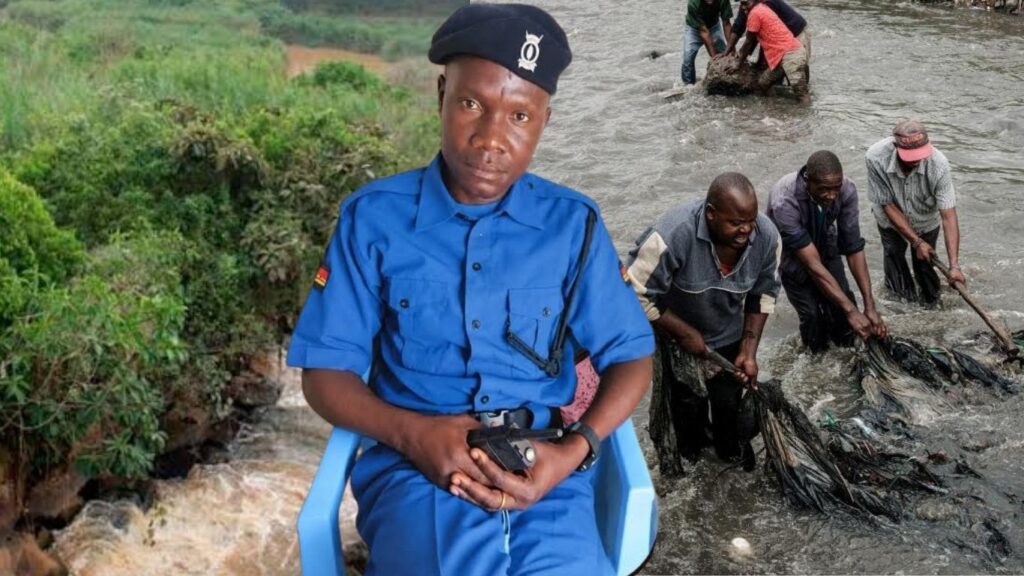
The discovery of the 46-year-old officer’s body has reopened painful memories of the River Yala deaths, where dozens of bodies were recovered amid demands for investigations and accountability.
The discovery of the body of a missing police officer in River Yala, Siaya County, has renewed public concern over a disturbing history of unexplained deaths associated with the river.
Police Constable Manase Olambwe Ndakala, a 46-year-old officer attached to Emusire Police Station in Vihiga County, was found dead approximately 14 days after he went missing.
According to a police report cited by local media, Ndakala disappeared on October 17, 2026, with his absence formally reported at Emusire Police Station on October 22.
His body was discovered on Friday, October 30, floating along the banks of River Yala in Omindo Village, Gem Sub-County, after a local resident grazing livestock spotted it and alerted authorities through local administration officials.
Police officers from Yala and investigators from Gem and Emuhaya visited the scene before retrieving the body with assistance from members of the public.
The deceased was positively identified by his brother, Henry Ndakala. His body was subsequently transferred to Coptic Private Hospital mortuary in Luanda, Vihiga County, pending a postmortem examination.
Investigations into the circumstances surrounding his disappearance and death are ongoing. Authorities are expected to establish how he died and how his body ended up in the river.
River Yala’s disturbing history of recovered bodies
Ndakala’s death has brought renewed attention to River Yala, which attracted national and international attention in 2021 and 2022 following the recovery of dozens of bodies from its waters and surrounding areas.
The discoveries triggered widespread outrage, with human rights organisations questioning how so many bodies could end up in the river without satisfactory explanations.
In January 2022, Amnesty International Kenya conducted a fact-finding mission and reported that bodies had been retrieved from the river between July 2021 and January 2022.
The organisation documented discrepancies in the numbers recorded by human rights defenders, the Yala Sub-County Hospital mortuary and the Directorate of Criminal Investigations.
Amnesty reported that human rights defenders had documented 31 bodies, while the hospital mortuary had recorded 21 and the DCI 19.
The organisation also raised concerns about physical injuries observed on some of the recovered bodies and called for comprehensive forensic investigations, proper identification of victims and accountability for those responsible.
Families searched for missing relatives
The discoveries turned River Yala into a painful destination for families searching for loved ones who had disappeared under unclear circumstances.
Some bodies were reportedly found in sacks, while others had injuries that raised questions about possible torture and violent deaths.
In March 2022, the body of Kenya Wildlife Service Chief Inspector Francis Oyaro was identified among those recovered from the river through DNA testing.
Oyaro had disappeared on August 28, 2021, while travelling from Marsabit to Nairobi in a KWS vehicle.
His identification brought the number of positively identified victims to 12 at the time, according to Citizen Digital.
For many families, the recovery of their relatives’ remains provided an opportunity to bury their loved ones, but questions about how the victims died remained.
Human rights organisations raised alarm
The Kenya National Commission on Human Rights also investigated the River Yala discoveries.
In an advisory concerning a parliamentary petition on enforced disappearances, the commission reported that at least 27 bodies had been retrieved from the river between early 2021 and March 2022.
The commission further noted that investigations initiated by police had, at the time of its assessment, not resulted in anyone being held accountable for the deaths.
The Independent Policing Oversight Authority also announced investigations into extrajudicial killings and enforced disappearances, including the recovery of bodies from River Yala.
The discoveries became part of a wider national debate about police accountability, enforced disappearances and the protection of fundamental human rights.
Fresh questions following Ndakala’s death
The discovery of Ndakala’s body has once again placed River Yala under public scrutiny.
However, it is important to establish that the circumstances surrounding his death have not yet been publicly linked to the earlier River Yala killings.
Investigators will need to establish where he was before his disappearance, the circumstances leading to his death and whether there is any evidence of foul play.
His death also raises questions about the safety of officers and the need for thorough investigations whenever individuals disappear under unclear circumstances.
For the family of Manase Ndakala, the immediate priority is to establish the truth about his final days and obtain justice if a crime was committed.
For families who lost relatives in the earlier River Yala incidents, the latest discovery is another reminder of questions that have remained unanswered.
River Yala has a history that Kenya cannot afford to ignore. Every recovered body represents a human life, a family and a search for answers.