
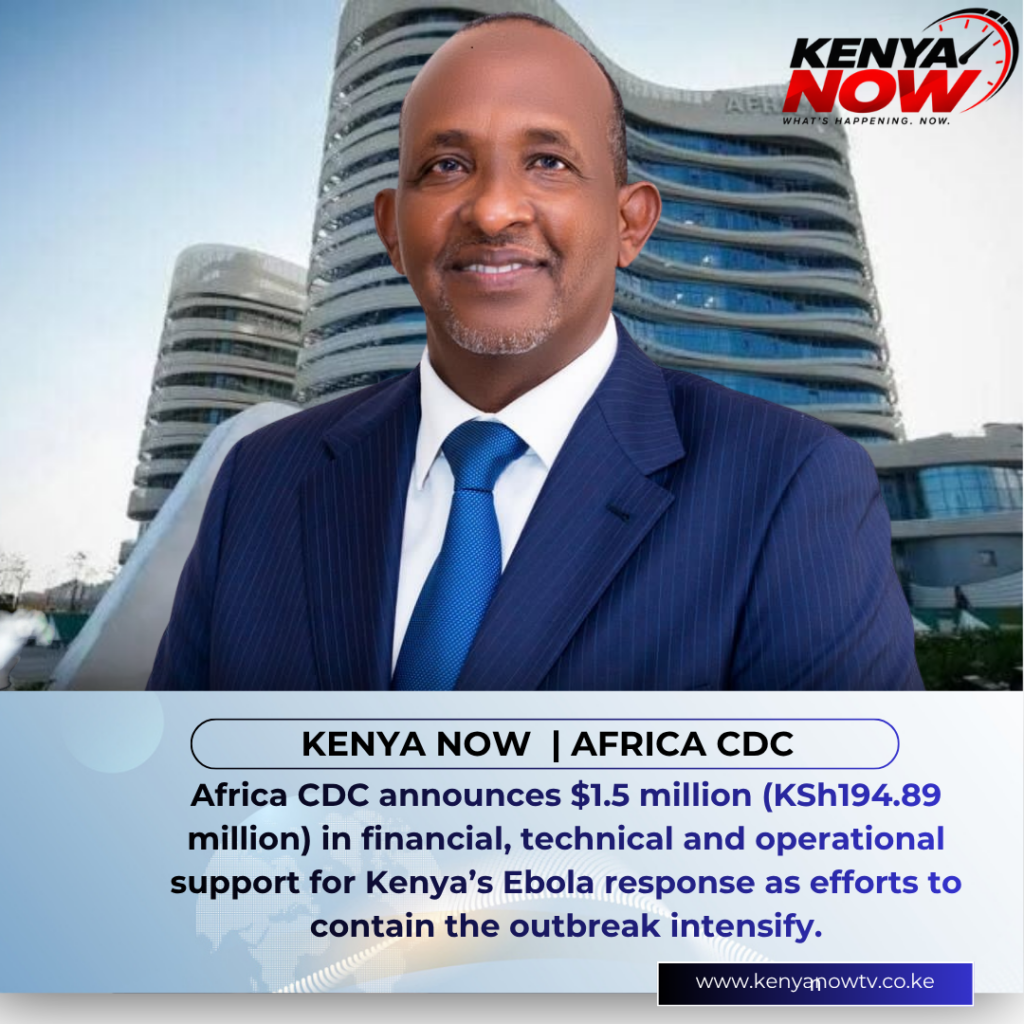
The Africa Centres for Disease Control and Prevention (Africa CDC) has mobilised approximately KSh194.89 million to support Kenya’s response to the Ebola outbreak, providing financial, technical and operational assistance as health authorities intensify containment efforts.
The announcement followed a meeting between Africa CDC Director-General Dr Jean Kaseya and Health Cabinet Secretary Aden Duale in Nairobi on Tuesday, October 27, 2026.
The continental health agency said the support would strengthen disease surveillance, laboratory testing, contact tracing, patient care and community engagement as Kenya works to prevent further transmission of Bundibugyo virus disease, a form of Ebola.
Africa CDC Deploys 10 Public Health Experts
The KSh194.89 million support package includes the deployment of 10 African public health experts to assist Kenya’s national response teams.
Africa CDC will also provide laboratory reagents and diagnostic test kits to strengthen the country’s ability to detect infections and respond to suspected cases.
Other areas receiving support include:
- Disease surveillance and contact tracing.
- Case management and support for patient care.
- Community engagement and public health communication.
- Technical assistance to coordinate emergency response operations.
Africa CDC said the measures were intended to reinforce Kenya’s ongoing containment efforts and reduce the risk of the virus spreading across borders.
Dr Kaseya commended Kenya’s leadership, emphasising the importance of early detection, timely intervention and coordinated action in responding to public health emergencies.
Additional KSh45 Million for Emergency Operations Centre
Separately, Africa CDC announced equipment valued at approximately US$350,000, equivalent to about KSh45.48 million, to strengthen Kenya’s Public Health Emergency Operations Centre.
The equipment is intended to improve the centre’s ability to coordinate public health emergencies, support response teams and manage information during outbreaks.
When combined with the announced US$1.5 million support package, the two commitments represent approximately US$1.85 million, or KSh240 million, based on the reported exchange-rate conversions.
Africa CDC and the Ministry of Health said cooperation between national governments and continental institutions remains essential in controlling outbreaks and protecting communities.
The agency has also convened an extraordinary meeting of African health ministers on October 28 to assess the evolving Ebola situation and strengthen coordination across the continent.
Kenya’s Ebola Situation
The support comes as Kenya continues to manage an outbreak of Bundibugyo virus disease.
According to health updates reported on October 26, Kenya had recorded nine confirmed cases, including two deaths. Seven patients remained under treatment, while 20 contacts of the initial case had completed 21 days of monitoring without symptoms and were released from quarantine.
Another 98 contacts remained under monitoring, with health authorities continuing surveillance and other containment measures. The confirmed cases were linked to a single cluster, and officials had reported no evidence of wider community transmission at that point.
The outbreak began with an imported case involving a Kenyan national who had travelled from the Democratic Republic of the Congo through Uganda. The patient subsequently died, and further cases were identified among people linked to the initial infection.
Health authorities have been tracing contacts, isolating confirmed cases, conducting laboratory tests and monitoring people who may have been exposed.
Regional Cooperation Remains Critical
Africa CDC said Kenya’s response is important not only for protecting its population but also for reducing the risk of cross-border transmission.
The outbreak has heightened the importance of cooperation among countries in the region, particularly in surveillance, information sharing, laboratory readiness and infection prevention.
The agency reaffirmed its commitment to working with the Kenyan government and other partners as containment operations continue.
For Kenya, the latest assistance provides additional technical capacity and equipment at a time when health authorities are working to monitor exposed individuals, manage confirmed cases and prevent further infections.
The effectiveness of the response will depend on sustained surveillance, timely identification of new cases, cooperation from affected communities and continued coordination among health agencies.
With additional African public health experts and emergency-response equipment being mobilised, authorities are seeking to strengthen containment efforts and prevent the outbreak from spreading further.